Friday, April 25, 2008

Did You Know?


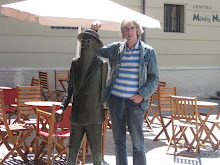
Image by Barry Kay, Set Designer

Galicia and the neighbouring region of Castilla y León produce 20% of Spain's wind energy but consume only 8% of the total.

Jousting with Giants

Friday, April 18, 2008

The Long Way Round

On 1 April, two Cantabrians set out from Torun, Poland, on a trek that they hope will take them to Santiago de Compostela. Eduardo Benájes (58) and Jesús Molleda(62), expect their walk will take three months to complete.

Their route passes through Germany and France to Roncevalles on the French-Spanish border. When they arrive in Spain, they plan to opt for the Northern Way, across the Basque Country, Cantabria and Asturias. The two hardy souls have been awarded €1,000 by the Cantabrian culture department. However, they estimate their journey will cost fifteen times that amount.

La Via Regia or Regal Way, is an old medieval route connecting Eastern Europe with Paris before it heads south for Santiago. It was an old commercial route used by merchants in the Middle Ages, passing through key German cities like Leipzig and Frankfurt. This is also known in Germany as the Salt Route. Another way begins in Kiev, some 5,000 miles from Santiago de Compostela.

Rising in the Dark

As I have to get up earlier these days, I wasn't too happy when the clocks went forward. Geographically, it would make sense for Galicia to be on the same time as the UK and Portugal, but of course we are an hour ahead. According to an article in La Voz there is 40 minutes difference in the daylight hours between Catalonia in the east and Galicia in the west. I ask myself why we need to have daylight until 9pm at the end of March, while we have to get up in the dark just before 8am.

Tuesday, March 18, 2008

Santiago Syndrome

Psychiatrist, Jesús de la Gárdara, has studied 38 cases of "Santiago Syndrome" in the last 7 years. All the sufferers have 3 characteristics in common: they are affected by strong mystic feelings, fatigue from so much walking, and they have a history of psychiatric conditions.

70% of those who suffer from this syndrome which strikes while walking to Santiago are males. The average age of the sufferer is 40.

Symptoms include: psychiatric episodes, delirium and intense emotional disorders of a manic nature accompanied by paranoia.

The victims spent 10 days in a psychiatric unit in Burgos and only 4 of them continued with the walk. The rest went home.

Translated form an article in La Voz de Galicia, 27 Sep. 2007

Sunday, March 2, 2008

The Hercules Legend


As most people know, Hercules, son of Zeus, was a nasty character who killed his wife and children and was punished by the oracle of Delphi. King Eurystheus set Hercules the task of tracking down Gerion.

Hercules used the same boat for his journey that the Sun had used on his travels. However, the Sun did not want to hand over the boat but decided it was for the best after a salvo of arrows from Hercules. On his voyage he had to threaten the Ocean who tried to sink his boat.

According to one version of the legend, Hercules came ashore in Galicia. After killing Eurition and his dog on Ons Island, where Gerion had taken refuge, the son of Zeus set out again in pursuit of the giant. Gerion arrived first at Punta Hermina. He raised his boat on his shoulders and climbed to a clifftop where he hid under the vessel to rest. But Hercules was smart and guessed his hideout.

The two giants had a fight to the death which lasted three days and three nights. Hercules decapitated his enemy and buried his head in the ground. This image appears in Coruña’s coat of arms with the skull and crossbones of Gerion. Hercules lit a bonfire as a sacrifice to Zeus. The bonfire was the original “lighthouse”, which would later become the Tower of Hercules. Legend claims that Hercules built the tower himself using the same stones he used for Gerion’s tomb.


In thanks, King Eurystheus ordered resettlement of the zone. One theory is that the city was called Cruña after the city’s first female inhabitant.

Wednesday, February 20, 2008

More Stats! Emigrants This Time

Over 325,000 Galicians living abroad have the right to vote in next month’s Spanish general election. Did you know that there has been so much emigration from Galicia to Argentina over the years that Spanish immigrants in general are known as Gallegos?

Below are the ten countries with the highest number of Galician emigrants:

Argentina (116, 682)
Venezuela (33,109)
Switzerland (29,253)
Brazil (29,156)
Uruguay (28,438)
France (16,057)
Germany (13,356)
UK (10,033)
USA (9,397)
Cuba (9,516)

Source – La Opinion 29th Jan. 2008

Tuesday, February 19, 2008

Cheers

As you may have noticed, there are no shortage of cafes, bars and restaurants in Spain. A report published at the end of last year, tells us that Cyprus is the only EU country with more bars per head of population. Galicia is the Spanish region with the third highest number of bars per person, with a bar for every 165.1 people. But Galicia’s neighbours have even more choice. Asturias has a bar for every 163.9 inhabitants and Castilla y León comes in second (164.9). However, the larger region of Andalusia has the most bars (35,981).

In culinary terms, Catalonia has the highest number of restaurants (11,564, although this figure also includes cafes) and for your fill of caffeine, the Valencian community has plenty of choice, with 2,324 cafes.

Source – Mercasa and INE. Info published in the Galician language daily, De lunes a venres.